

The LA in LA Galbi stands for Los Angeles.
After hearing restaurant owners and content creators such as Jenee Kim of Park's BBQ in Los Angeles claim that LA stands for Lateral Axis in Los Angeles Times article and seeing Korean Food creators like Cafe Maddy repeat the same claim… I said enough is enough! I'm going to the bottom of this pointless argument so I know for sure what LA Galbi stands for.
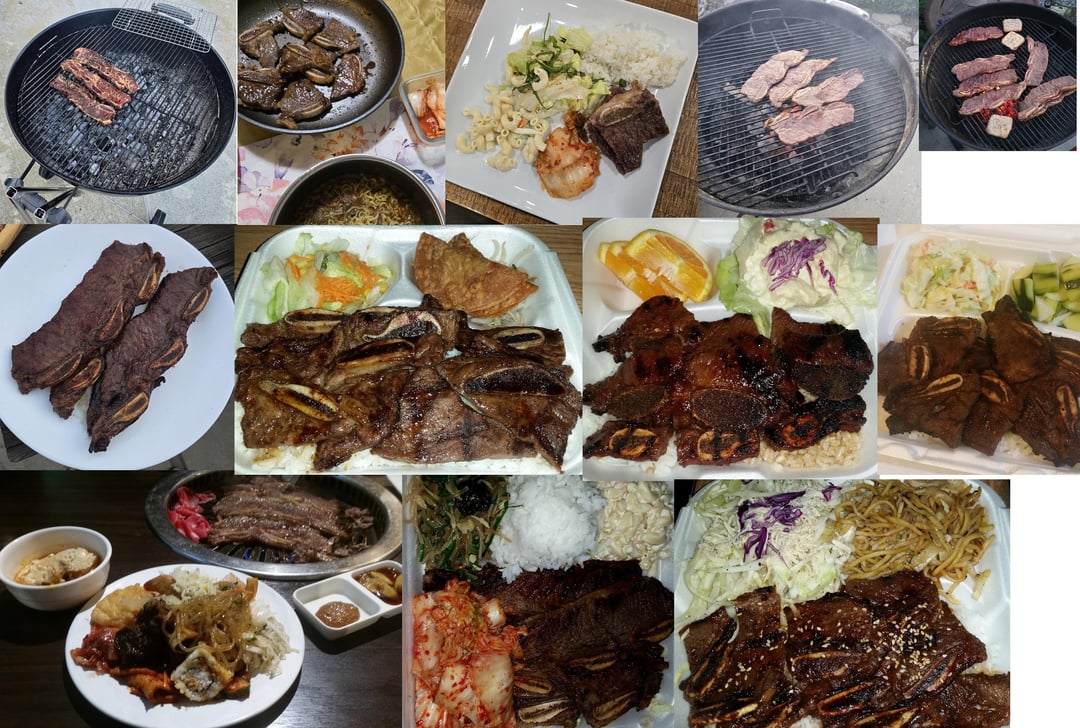
What is LA Galbi? LA Galbi is a flanken-cut style of beef short ribs, typically cut across three bones and marinated in Korean flavors. The flanken cut has long been popular in the Hispanic and Jewish communities of Los Angeles, and Korean immigrants simply used what was already available at local butcher shops to create what we now call LA Galbi. You can see in photo 1 of this reddit post that I made a collage of all the different types of LA Galbi I had personally and yes, I ended up getting lazy realizing I ate way too much of LA Galbi during the past few years.
Why I believe LA stands for Los Angeles is due to the evidence in American Newspaper articles.
The Evidence
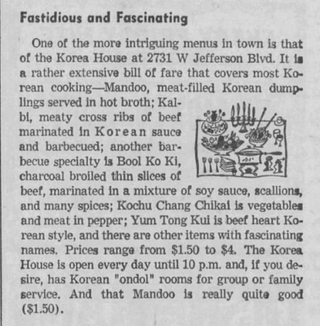
The earliest reference I could find to the flanken-cut style being used for galbi appears in the September 15, 1963 issue of the Los Angeles Times, in a piece about The Korea House believed by some historians to be the first Korean restaurant in Los Angeles. The article describes "Kal-bi" as meaty cross ribs of beef marinated in Korean sauce and barbecued. "Cross ribs" is consistent with the flanken cut, where the knife crosses the bones rather than following them.
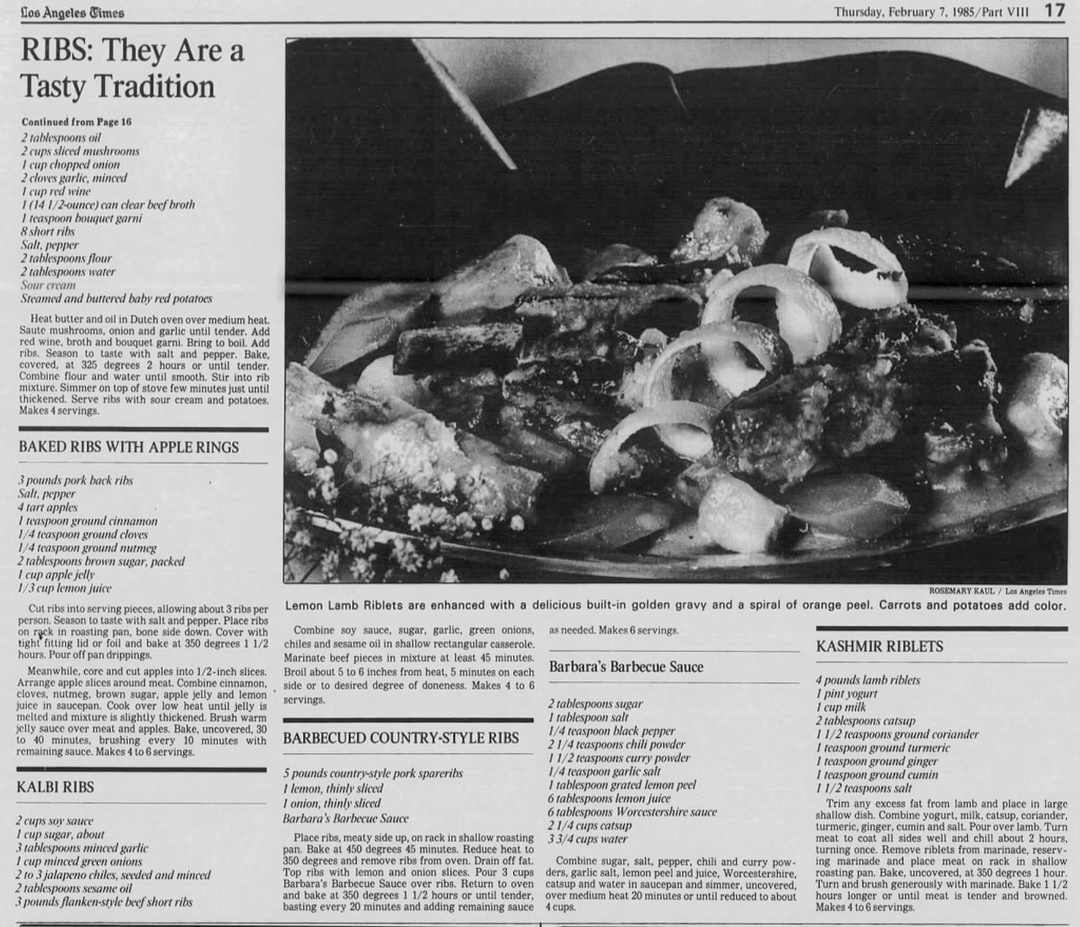
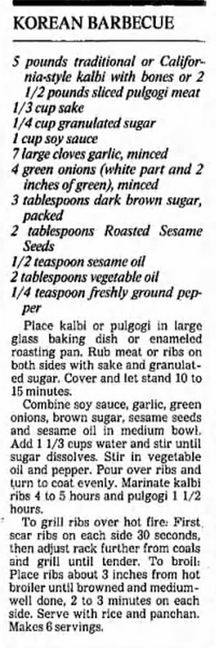
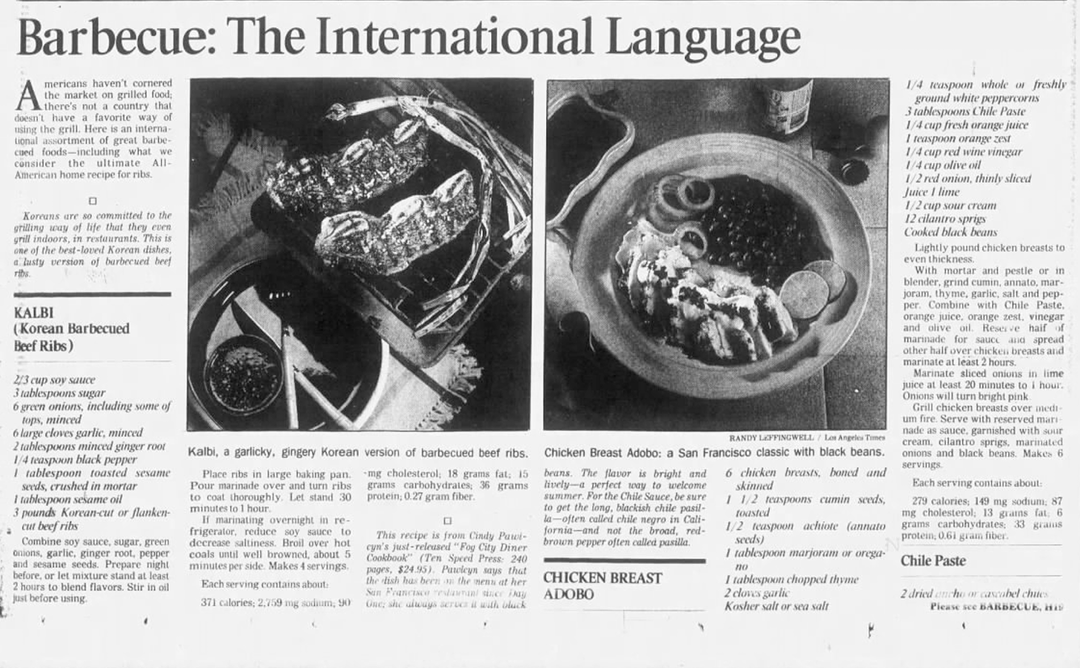
The next reference appears in a February 7, 1985 Los Angeles Times article on ribs, which includes a Kalbi recipe that specifically calls for flanken-style beef short ribs, the first time I found the term used explicitly in this context.
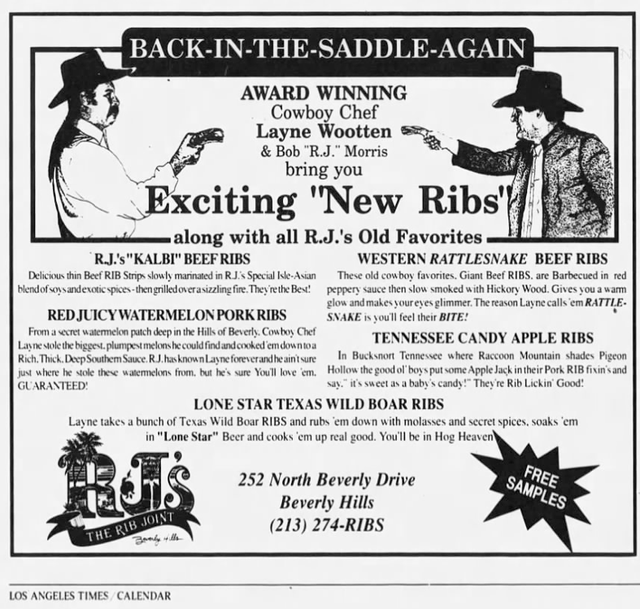
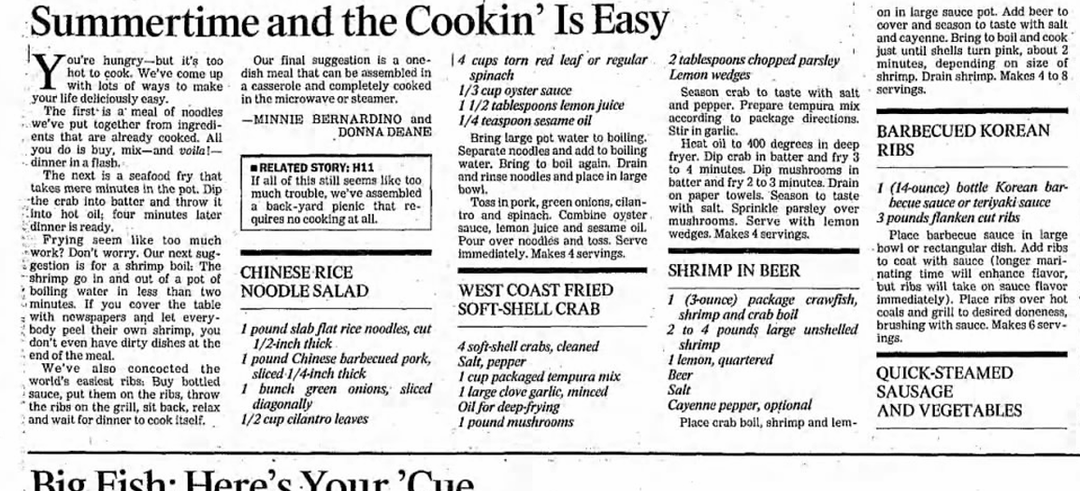
A December 3, 1989 LA Times advertisement for RJ's restaurant describes thin beef rib strips prepared in the same flanken style. This is notable, as this is an American BBQ joint, showing the cut had crossed over beyond Korean restaurants by this point.
Finally, a November 15, 1990 LA Times article on Koreatown Plaza describes what it calls "California-Style Kalbi" — a cut identical to what we know today as LA Galbi. This is the earliest named regional label I could find for the dish.
Taken together, this trail of primary sources points consistently and specifically to Los Angeles as the origin of the flanken-cut galbi style and not a butchery technique called "Lateral Axis," which, notably, is not a recognized term in butchery at all.
This Namu Wiki also has evidence about LA Galbi.
Asking older Korean individuals who happen to live in Los Angeles, a lot of them have similar stories of how Korea House might have been the first place to have LA Galbi. Others argue that it was this butcher shop called Brother's Butcher shop and Market that was the first place to suggest this type of flanken-cut style meat for Galbi. The story is that a restaurant/night club called the Tiger Room would buy meat from Brother's Butcher shop and they suggested to cut in between the bones so it was easy to eat as an Anju (안주). Supposedly the Tiger Room would be the first restaurant to add Coca Cola into their marinate which would make the meat sweeter as well as tenderize the meat. Korean airplane stewardess would buy frozen Galbi byt the bulk from the Tiger Room and take it to many places such as Hawaii and back to Korea.
At the end day, who really cares. If your grandmother claims she invented LA Galbi, maybe she's right. I don't really know but my understanding is LA stands for Los Angeles. Now I have to deal with the city of Riverside claiming they have the first Koreatown… which is a lie but that is another story for another time.
TLDR: The LA in LA Galbi stands for Los Angeles.
by No_Cucumber_739
10 Comments
First I’ve ever heard lateral axis to describe. Must be some gen-z bullshido pulled out of some pretentious ass. Always has been LA style for los angeles.

I never knew this was a debate. There’s no way that 1st gen Korean Americans were calling it “lateral galbi”.
My favorite is using cola as part of the marinade. Helps tenderize the meat and sweeten the sauce.
Italians had rib cuts like this in NYC long before LA had Korea Town.
Tagliata style: In some regions, thin ribs are seasoned simply with olive oil, rosemary, and garlic, then grilled fast over high heat—almost identical to the Korean method, just with a Mediterranean flavor profile.
I’d say lateral axis is just an attempt to invent a “backronym” for LA.
Like the morse code “SOS” was initially just chosen as a distinctive code without being an abbreviation. The backronym “save our ship / save our souls” was only popularized later.
When I immigrated from Korea to the US (NYC), I thought LA galbi was the bomb.
In Korea, my parents were involved in a *gyemoim*, a small community-based savings pool. The entire family commonly participated in the monthly gatherings where dues are collected and members gather to eat and socialize. During these gatherings, a participant takes turns buying a dinner instead of paying the monthly dues. The meals were typically expensive — either galbi or sashimi (hwe) restaurants.
When I arrived in the US, I was told by my relative that LA galbi became a thing because this particular cut was readily available. Specifically in LA, commonly from Mexican butchers. The cut is also easier to marinate and cook, especially on American-style BBQ grills.
Anyway, I loooooved LA galbi. Instead of savoring a small piece of Korean galbi, with LA galbi, I could devour the entire cut, allowing me to experience the full juicy flavor.
lateral axis galbi…
lol
Lmao I thought this would be about the best galbi in LA and was excited to open this thread
I don’t know what it stands for….But if it is “Lateral Axis”, it now makes a LOT more sense to me. I am korean, but lived in chicago growing up. All Kalbi was done in LA galbi style, in shops, at home, in restaurants. I moved to LA as an adult. In most Kalbi places in LA (Suwon Galbi, Chosun Galbi, Genwa, Baekhwajung, etc. It was cut differently. Thick bone, and then the meat cut into a ribbon. It may have been the first time I saw it cut this way. But it seemed consistent at any of the higher end galbi joints, so I was so confused as to why stores would sell “LA galbi”, as cut across the bone….
So I am going to go with Lateral Axis, no matter what it is to not have the cognitive dissonance of it referring to the city, where no one sell it cut that way.
They all suck. Very inconsistent. Tend to up end price and feed you pretty much corn starch in all their marinades. Cook your own Korean or go to Korea. Americans turn everything to an opportunity to make more money.